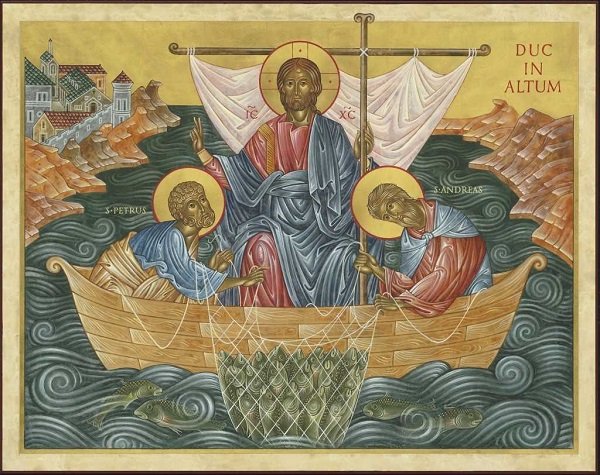
Again the kingdom of heaven is like to a net cast into the sea, and gathering together of all kinds of fishes. Which, when it was filled, they drew out, and sitting by the shore, they chose out the good into vessels, but the bad they cast forth. So shall it be at the end of the world. The angels shall go out, and shall separate the wicked from among the just. And shall cast them into the furnace of fire: there shall be weeping and gnashing of teeth.
Have you understood all these things? They say to him: Yes. He said to them: Therefore every scribe instructed in the kingdom of heaven, is like to a man that is a householder, who brings forth out of his treasure new things and old. And it came to pass: when Jesus had finished these parables, he passed from there.
The parable of the dragnet begins gently enough, with an image familiar to any Galilean fisherman: a net cast wide into the sea, gathering fish of every kind. But Jesus does not leave us in the comfort of the shoreline. He carries the image forward to the end of the age, when the angels will separate the evil from the righteous, and the wicked will be thrown into the furnace of fire, “where there will be weeping and gnashing of teeth.” This phrase, which Our Lord uses repeatedly in Matthew’s Gospel, deserves our serious attention rather than our polite avoidance. The Church has never treated these words as mere rhetorical flourish. They describe a real possibility for every human soul: the possibility of final separation from God, freely chosen and eternally ratified.
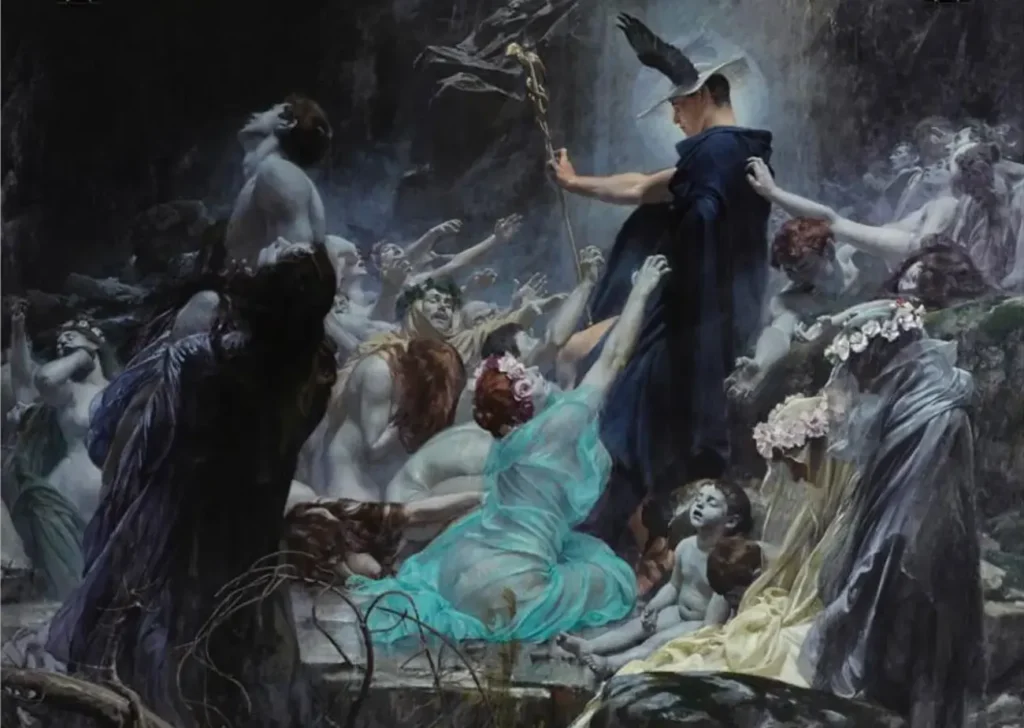
What, then, is this gnashing of teeth? The Fathers of the Church saw in it the anguish of a soul that recognizes, too late, what it has lost. Weeping expresses sorrow; the gnashing of teeth expresses something more terrible, a grief mingled with rage, frustration, and self-reproach. It is the torment not primarily of external punishment but of interior realization: the soul sees clearly, at last, that God was its true good, that every sin was a turning away from infinite Love, and that the loss is irrevocable and self-inflicted. St. Augustine and St. Thomas Aquinas both taught that the deepest pain of hell is this loss of the vision of God, the poena damni, beside which the fire itself is secondary. The gnashing of teeth is the sound of a will still locked in rebellion, unable to repent because it no longer wishes to, grinding against a reality it cannot change. This is why the saints wept over sin more than over any earthly suffering—they understood what was truly at stake.
Yet we must remember that Jesus speaks these sobering words not to terrify us into despair but to awaken us while there is still time. The net has not yet been drawn ashore; the sorting has not yet begun. Every moment of this life is an offer of mercy, and the same Lord who warns of the furnace stretched out his arms on the Cross to save us from it. The proper response to today’s Gospel is not paralysing fear but a healthy fear of the Lord, the beginning of wisdom, that moves us to confession, to conversion, and to fervent charity. Examine then our consciences honestly, return to the sacraments with contrite hearts, and pray especially for those who have wandered far from God. For the treasure of the kingdom, both old and new, includes this ancient truth spoken anew to our generation: heaven is real, hell is real, and the God who desires that all be saved has placed the choice, with awesome dignity, in our hands.