Passover can be approached from two directions. There is the microcosm: the sacred meal itself, with its sequence of cups, its ordered recollection, its fulfilment in the Upper Room and on the Cross. And there is the macrocosm: the whole arc of Christ’s public ministry, which can be read as moving according to that same deep pattern, from the Jordan to Golgotha. On this reading, the four cups don’t only illuminate the final night; they cast their light backward across the entire life by which Christ prepared for that hour.
This is offered as theological reflection on the unity of Christ’s ministry, not as a strict exegetical claim. The Gospels don’t present his life as a string of disconnected episodes. They present one work moving steadily toward a single fulfilment. The One who enters the waters, proclaims the Kingdom, offers the cup at supper, and drinks the final draught on the Cross is always the same Christ, gathering everything into himself.
The four cups are traditionally named: sanctification, proclamation, redemption, and consummation. What makes the Gospel narrative arresting is that Christ doesn’t treat the Upper Room meal as complete in itself. He says he will not drink again of the fruit of the vine until the Kingdom comes. Later he speaks of the chalice the Father has given him. On the Cross, he receives the sour wine and declares that everything is finished.
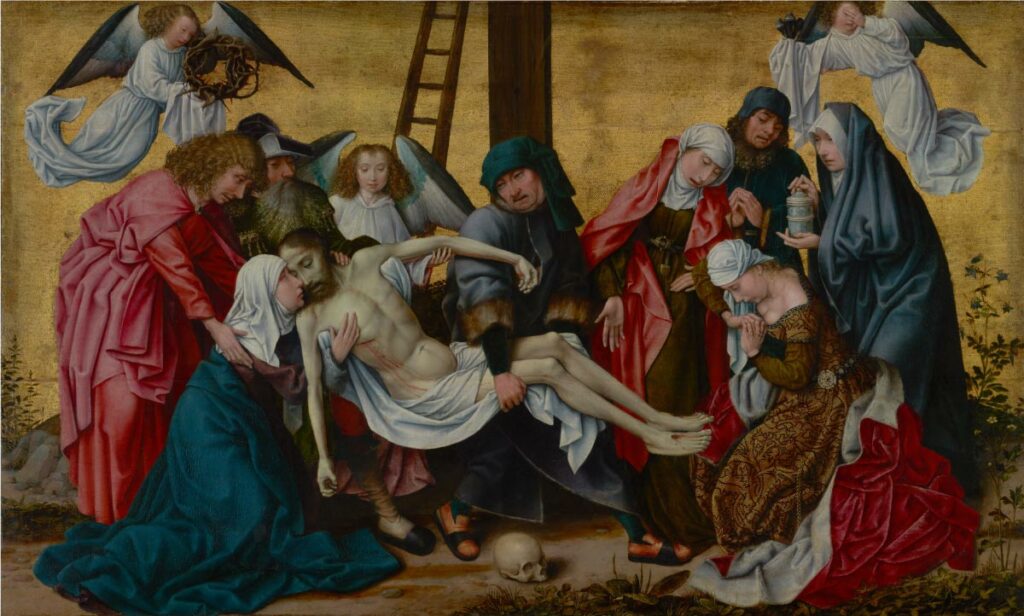
The impression is hard to escape. The Supper reaches beyond itself. It is not merely followed by the Passion; it is fulfilled in it. The table leans toward the Cross. The cup offered sacramentally in the Upper Room is answered by the cup accepted bodily in suffering. Christ doesn’t only speak of redemption; he brings it to completion in his own flesh. The Passover doesn’t stay behind when he leaves the room. It goes with him into the garden, to the tribunal, and up to the hill of sacrifice.
If that is true in the microcosm, it’s worth asking whether the same pattern can be seen in the larger shape of his public ministry. If the final Passover condenses and concentrates the mystery, might the whole ministry be that same mystery extended across time? Might baptism, proclamation, supper, and Cross stand to one another as a kind of great Passover movement, unfolded across the whole of Christ’s work?
The First Cup: Sanctification — the Jordan
The cup of sanctification finds its most natural home at the baptism in the Jordan, and the depth of meaning there is greater than it first appears. The Jordan already carries the memory of Israel’s history. After the Exodus, after the wilderness, it was the Jordan that Israel crossed to enter the Promised Land. The first Passover cup recalls how God set Israel apart as his own people, delivering them from bondage and claiming them for himself. Paul already understood Israel’s passage through the cloud and the sea as a kind of baptism, a rebirth of the people under God’s hand. It is fitting, then, that Christ should begin his public ministry at the very river that bore that memory of passage, separation, and entry into promise.
This requires care. Christ was not sanctified at the Jordan as though he lacked holiness beforehand; he is holiness itself. But by entering the waters he sanctified them for our sake. The sinless One descends into the river not to be cleansed but to make cleansing holy, to hallow the waters by his presence, to prepare them as an instrument of grace for all who would follow. At the same moment, his mission is publicly manifested: the heavens open, the Spirit descends, and the Father declares the beloved Son. The first cup is the cup of sanctification because it recalls the setting apart of God’s people. So too the baptism of Christ stands at the threshold of the New Covenant, where the waters themselves are made holy and the way is opened for a new and greater people to be set apart for God.
The symbolism deepens still further. Under the old covenant, Israel was marked out from the nations as the people of promise. Under the new covenant, baptism becomes the defining rite by which the new Israel is gathered and claimed. What circumcision and the Exodus signified beforehand, baptism now effects in a higher mode. By baptism men are joined to Christ, reborn, and incorporated into his Body. The first cup, which speaks of sanctification and a people set apart, finds its echo at the Jordan, where Christ sanctifies the waters and lays the foundation for the sacramental entry of his new people.
One can glance at Cana and see a lovely foreshadowing; the first sign is already a sign of wine and glory. But the Jordan remains the stronger threshold. There the mission begins under the sign of holiness. There the old history of Israel, with its exodus, wilderness, and crossing, is quietly gathered up and turned toward fulfilment. There the Messiah, who is himself our sanctification, enters the waters so that his people may one day enter them after him and come forth renewed.
The Second Cup: Proclamation — the Preaching of the Kingdom
The cup of proclamation corresponds to Christ’s preaching of the Kingdom. In the Passover meal the mighty acts of God are recounted. In Christ’s ministry the great deliverance is proclaimed anew, but with a difference so astonishing it transforms everything: the speaker is himself the centre of the story. He is not merely describing salvation. He is bringing it near. He is not only interpreting Israel’s history. He is revealing its fulfilment in his own person.
This gives a deep unity to his preaching and his signs. The blind see, the lame walk, the unclean are cleansed, sins are forgiven, demons are driven out, and the poor hear the good news. The Exodus was a true deliverance, but it was still a shadow of something greater. Egypt was a house of bondage, but humanity laboured under a darker bondage still. Christ’s proclamation of the Kingdom is the second cup enlarged and made living: the story of deliverance is no longer told as past memory but announced as present reality. God is acting now, and acting in him.
The Third Cup: Redemption — the Last Supper
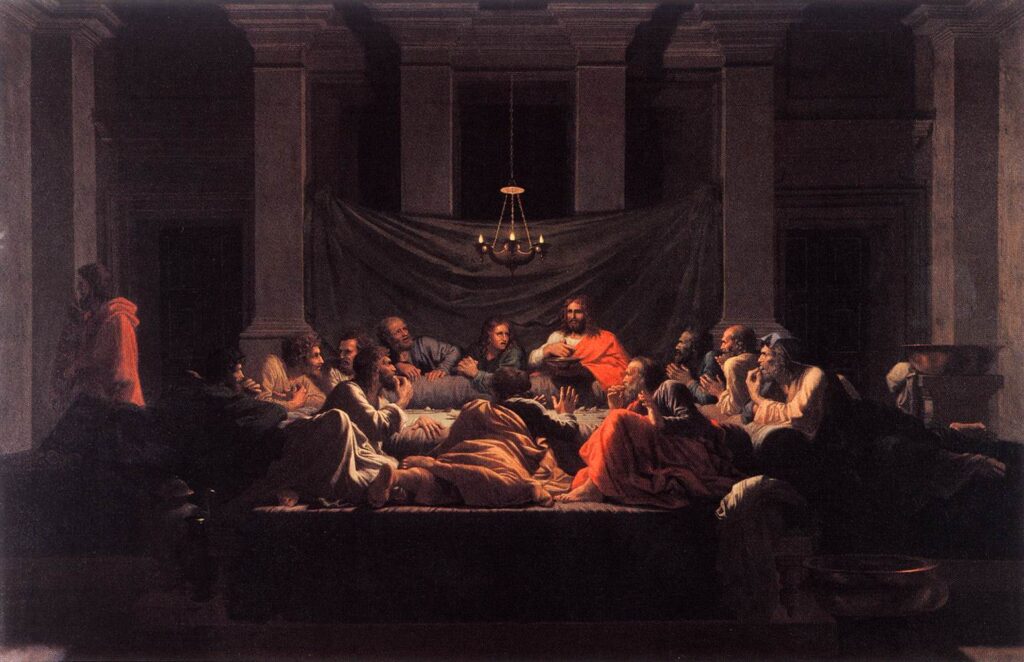
The cup of redemption narrows the reflection into the Upper Room. At the Last Supper Christ takes the cup and gives it to his disciples as the blood of the new covenant. All that was prepared in sanctification and unfolded in proclamation now passes into sacrificial nearness. Redemption is not merely spoken of; it is placed into their hands sacramentally. The old Passover had looked back to the lamb’s blood on the doorposts. The new Passover looks to the blood of the true Lamb, who is himself both Priest and Victim.
There is something deeply moving in the order of this. Christ gives beforehand what he will shed the following day. He places into his disciples’ hands the mystery he is about to accomplish on the Cross. The Eucharist is therefore neither an afterthought to Calvary, nor is Calvary merely a sequel to the Supper. The two belong together. The sign is already full of the sacrifice, and the sacrifice fulfils what the sign contains. The cup of redemption at table is inseparable from the blood of redemption poured out on Golgotha.
The Fourth Cup: Consummation — the Cross
The fourth cup, the cup of consummation, is drunk on the Cross. Christ had spoken of the cup still to come. In Gethsemane he asks whether it might pass, yet accepts it entirely as the Father’s will. On Calvary he refuses the stupefying draught that would have dulled his suffering; the cup is to be drunk in obedience and full awareness. Finally he receives the sour wine, and then comes the great cry: it is finished. In this reading, that final cup is not a stray detail but the completion of the whole movement. What began in sanctification, advanced through proclamation, and was sacramentally given in redemption, is now brought to its appointed end.
Seen this way, the whole public life of Christ takes on the grandeur of a single sacred action. The Jordan, the roads of Galilee, the villages and synagogues, the Upper Room, the garden, and the hill of the Skull are not disconnected religious episodes. They are chambers of one mystery. The ministry unfolds with the solemn unity of liturgy: sanctification, proclamation, redemption, consummation.
One needn’t force every detail into exact correspondence for the pattern’s light to be visible. Its value lies not in mechanical precision but in the vision it gives of Christ’s perfect coherence, because Christ always gathers things into himself. He doesn’t leave signs scattered, prophecies half-joined, or feasts without fulfilment. He draws them together in his own person. Passover, sacrifice, covenant, proclamation, sanctification, and praise all find their centre in him. He is not one more figure moving through Israel’s inherited forms. He is the one in whom those forms reach their meaning.
That is why this reflection carries force. It preserves the sense that the Last Supper is not a lonely episode and that Calvary is not an isolated tragedy. Each opens into the other, and both are prepared for by everything that came before. At the Jordan he sanctifies the waters by entering them. In his preaching he proclaims the true deliverance. At the Supper he gives the cup of redemption. On the Cross he drinks the cup of consummation.
The old cups were shadows. In Christ they are filled. The old feast was a promise. In Christ it becomes reality. The old deliverance was mighty but incomplete. In Christ the final deliverance comes. And so his ministry can be read not merely as a succession of teachings and miracles, but as one great Passover: beginning in sanctified waters, sounding forth in the proclamation of the Kingdom, given sacramentally at supper, and brought to completion on the wood of the Cross.