Introduction
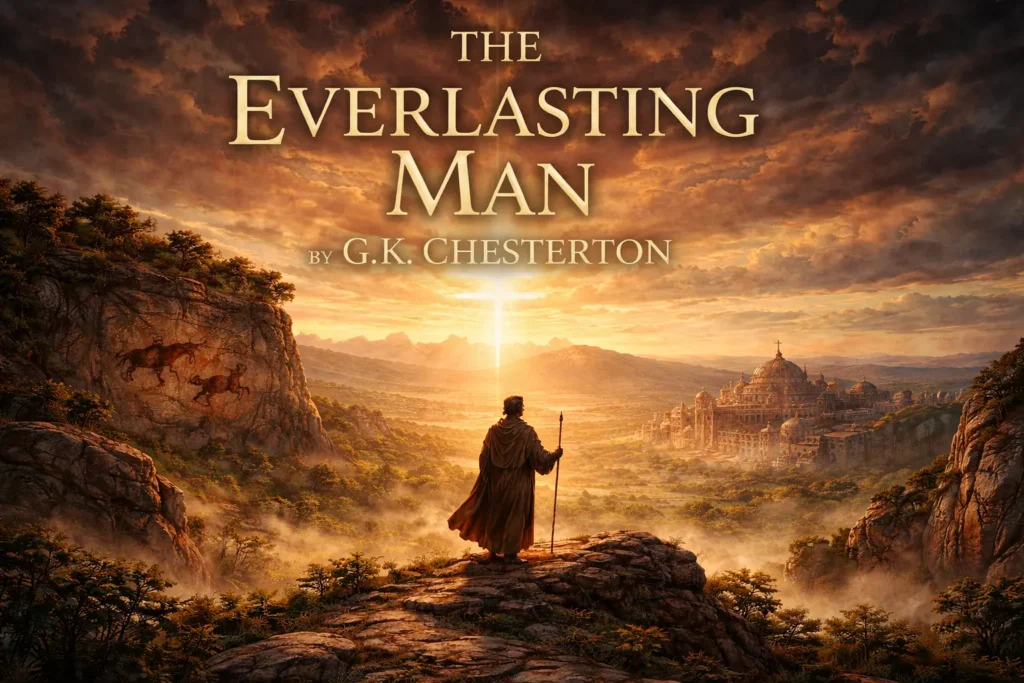
The Everlasting Man is G.K. Chesterton’s attempt to show that two things in history are far stranger than modern people tend to admit: the sudden appearance of man as a symbolic, meaning-seeking creature, and the appearance of Christ as a figure who refuses to fit into any normal category of myth, philosophy, or politics. Rather than starting with theology, the book begins with archaeology, anthropology, and mythology, slowly building toward the claim that Christianity is not merely one religion among many but something historically singular.
The structure moves in two sweeping arcs. The first half examines humanity itself, asking why the earliest humans already appear artistic, religious, and morally aware. The second half turns to Christ, presenting Him not as an inevitable product of religious evolution but as a shocking interruption in history. The cumulative case is that Christianity does not erase myth and philosophy but fulfils and overturns them simultaneously.
Part I – On the Creature Called Man
Chapter 1: The Man in the Cave
The earliest clear evidence of humanity is not better claws or sharper teeth, but art. Cave paintings appear not as hesitant experiments but as confident expressions of imagination and symbolic thought. From the very beginning, humanity seems preoccupied with beauty, story, and meaning. This is why it is possible to say that “art is the signature of man,” because the first unmistakable traces of humanity are aesthetic and symbolic rather than merely practical.
What emerges is a picture of humanity appearing already fully human in the deepest sense. The first men bury their dead, decorate their world, and express ideas beyond survival. There is no obvious halfway stage where animals slowly become religious. Instead, humanity appears as a creature already aware of mortality and mystery, already living in a world charged with meaning.
Chapter 2: Professors and Prehistoric Men
Modern confidence in progress often assumes technological advancement equals intellectual or moral superiority. Yet ancient societies show profound complexity of ritual, art, and symbolism long before modern machinery. In this light, it becomes clear that “the modern man is not necessarily wiser than the ancient; he is only later,” and historical lateness is not proof of wisdom.
Seen this way, human nature appears remarkably stable across time. The same questions about suffering, purpose, and God appear in early civilisations as strongly as in modern ones. Civilisation may change its tools, but it does not change its deepest concerns. Humanity has always wrestled with meaning, and that struggle appears woven into the species itself.
Chapter 3: The Antiquity of Civilisation
The first great civilisations appear abruptly and already sophisticated. Egypt and Mesopotamia do not look like experimental prototypes of society but like mature cultures with art, law, and religion already functioning at high levels. This suggests civilisation is not inevitable progress but something fragile. As the book observes, “civilisation is not something that grows like grass; it is something that must be guarded like a treasure.”
History therefore becomes less like a steady climb and more like a precarious balancing act. Cultures rise, flourish, decay, and sometimes disappear entirely. Moral and intellectual achievements are not guaranteed to endure. They must be protected, taught, and renewed constantly if they are to survive.
Chapter 4: God and Comparative Religion
Across cultures, religion shows humanity reaching toward the divine through ritual, sacrifice, and myth. Pagan religions often contain beauty, insight, and deep symbolic truth, yet they consistently fall short of full resolution. This is captured in the observation that “paganism was the biggest thing in the world, and Christianity was bigger,” because Christianity claims something radically different: not humanity discovering God, but God revealing Himself to humanity.
This reverses the normal religious pattern. Instead of heroic humans becoming divine, Christianity presents the divine choosing humility and entering human history. That claim alone sets Christianity apart from the surrounding religious landscape of the ancient world.
Chapter 5: Man and Mythologies
Mythology across cultures tells stories of sacrifice, redemption, and cosmic struggle. These patterns appear so consistently that they seem to reflect something deep in human psychology. Myth can therefore be seen as humanity intuitively reaching toward truth. In this sense, myth can be understood as “a hint of the truth,” while Christianity presents itself as the moment when that truth becomes historical reality.
Rather than contradicting myth, Christianity appears to complete it. The long human instinct that redemption must somehow come from outside history is answered by the claim that redemption entered history directly.
Chapter 6: Demons and the Philosophers
Greek philosophy represents one of humanity’s highest achievements of reason. Philosophers diagnosed human moral and existential problems with extraordinary clarity. Yet explanation alone could not fix the human condition. It remains true that “the philosophers could see the disease; they could not cure it,” because understanding suffering is not the same as removing it.
Reason alone can describe the human condition but cannot redeem it. Humanity needs more than analysis. It needs transformation, forgiveness, and hope that extends beyond intellectual clarity.
Chapter 7: The War of the Gods and Demons
By the time Christianity emerged, the ancient religious world showed signs of exhaustion. Religion often became dark or fatalistic, while philosophy offered insight but little comfort to ordinary people. The sense emerges of a civilisation spiritually drained, a world in which “the world was growing old in superstition and weary of wisdom.”
The stage was therefore set for something radically new. Christianity did not enter a confident religious world but one searching for meaning and stability.
Part II – On the Man Called Christ
Chapter 8: The God in the Cave
The story of Christ begins with another cave, this time at Bethlehem. Just as humanity first appears in caves, so too does the story of redemption begin in one. The paradox is captured in the striking image that “the hands that had made the sun and stars were too small to reach the huge heads of the cattle.”
This moment reframes power itself. Christianity begins not with conquest or philosophy but with vulnerability. The divine enters history not as a ruler but as an infant, overturning normal expectations about what divine power would look like.
Chapter 9: The Riddles of the Gospel
The personality of Christ does not resemble mythic heroes or purely philosophical teachers. Christ is simultaneously gentle and terrifyingly authoritative. In Him there exists “a thunderbolt of authority and a silence of humility,” a combination that feels psychologically unique.
The Gospels portray someone emotionally complex, unpredictable, and deeply personal. This complexity resists reduction to legend or literary invention and instead carries the texture of lived history.
Chapter 10: The Strangest Story in the World
Christianity’s survival through repeated crises becomes part of its historical strangeness. Empires, revolutions, and intellectual movements have repeatedly predicted its collapse. Yet the pattern continues in which “Christianity has died many times and risen again; for it had a God who knew the way out of the grave.”
The story spreads through weakness rather than power, through witnesses who often doubt and fail. That very imperfection contributes to its historical plausibility rather than weakening it.
Chapter 11: The Witness of the Heretics
Even opposition to Christianity often centres on Christ rather than dismissing Him entirely. The pattern appears repeatedly where disagreements exaggerate one truth while losing balance. It remains true that “every heresy is an emphasis on a truth separated from the whole.”
This demonstrates the central gravity of Christ in theological and historical debate. Even those who reshape Christianity rarely escape its central figure.
Chapter 12: The Escape from Paganism
Christianity reshaped moral imagination by elevating the weak, poor, and marginalised. It introduced the radical idea that every human life possesses inherent dignity. This is why it can be said that “the Church is the only thing that frees a man from the degrading slavery of being a child of his age.”
Christianity therefore becomes not merely a belief system but a civilisational force, reshaping law, ethics, and social structures across centuries.
Chapter 13: The Five Deaths of the Faith
Several moments in history appeared to signal the end of Christianity. Yet each time it survived and renewed itself. This historical pattern is summarised in the line that “at least five times the Faith has to all appearance gone to the dogs. In each case it was the dog that died.”
This resilience becomes part of the argument for Christianity’s uniqueness. It repeatedly survives conditions that have destroyed other movements.
Chapter 14: The Summary of This Book
The final reflection returns to the idea that Christianity creates both order and freedom. It establishes moral structure while encouraging human flourishing. Christianity created rule and order, yet its purpose was “to give room for good things to run wild.”
The final claim is that Christianity is not merely plausible but historically startling. It stands out rather than blending into the general pattern of religion.
Conclusion
The central argument of The Everlasting Man is that two things demand explanation: why humanity appears already symbolic, artistic, and religious, and why Christ appears unlike any other religious founder. Both seem less like gradual developments and more like dramatic entrances into history.
The enduring force of the book lies in reversing the usual question. Instead of asking whether Christianity fits neatly into history, it asks whether history makes sense without it. The suggestion is that Christianity is not merely one story among many, but the story that best explains why humanity is the way it is.