Introduction
The second century presented the nascent Christian church with numerous theological challenges, yet few proved as consequential as the teachings of Marcion of Sinope. This wealthy shipowner turned religious teacher arrived in Rome around 140 AD with ideas that would shake the foundations of Christian orthodoxy and force the church to clarify its core beliefs about God, scripture and salvation. His movement spread rapidly across the Roman Empire, establishing parallel church structures that persisted for centuries. The threat was so serious that early church fathers devoted considerable energy to refuting his doctrines, and in doing so they helped define what would become mainstream Christianity.
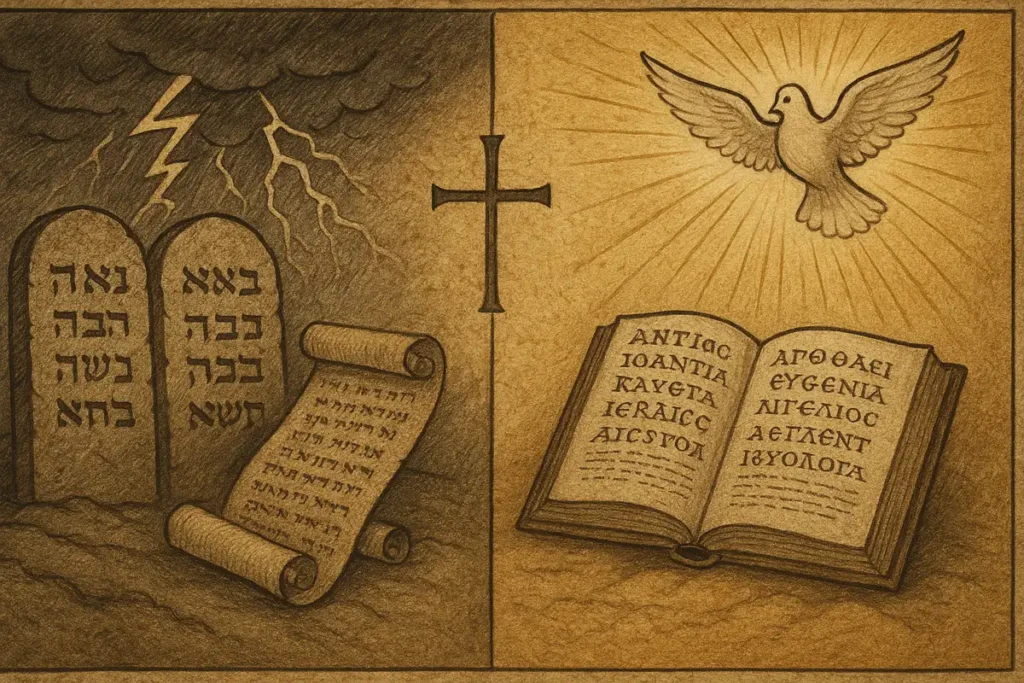
Marcion’s central claim was shocking in its simplicity: the God of the Old Testament and the God revealed by Jesus Christ were two entirely different deities. The former was a lesser, wrathful creator god obsessed with law and justice, whilst the latter was a previously unknown supreme God of pure love and mercy. This radical dualism meant rejecting the Hebrew scriptures entirely as irrelevant to Christian faith. Marcion compiled his own canon consisting of an edited version of Luke’s Gospel and ten of Paul’s letters, all carefully purged of references that suggested continuity with Judaism. His systematic approach to scripture, his organisational abilities and his substantial financial resources made Marcionism the most formidable alternative to what would become orthodox Christianity.
The Man Behind the Movement
Marcion was born in Sinope, a prosperous port city on the Black Sea coast of Pontus, probably around 85 AD. His father reportedly served as a bishop, though accounts differ on whether Marcion was excommunicated by his own father for his controversial views or whether this detail represents later hostile embellishment. What seems certain is that he possessed considerable wealth from maritime trade, which he used to support his religious activities.
Around 140 AD, Marcion travelled to Rome and donated an enormous sum to the church there, reportedly 200,000 sesterces. For several years he participated in the Roman Christian community whilst developing his theological system. However, by 144 AD, his teachings had become so controversial that church leaders rejected them and returned his donation. Rather than recanting, Marcion established his own church organisation, which quickly attracted followers throughout the empire.
Marcion’s personality emerges from the sources as earnest and ascetic rather than cynical or power-hungry. He appears to have genuinely struggled with the problem of evil and the apparent contradictions between the vengeful God of the Old Testament and the loving Father proclaimed by Jesus. His solution was to take Paul’s contrast between law and grace to its logical extreme, arguing that they came from different divine sources altogether. This intellectual honesty, combined with his organisational skills and financial backing, made his movement particularly dangerous to the emerging orthodox consensus.
The Core Doctrines
Marcionite theology rested on a fundamental dualism. The Demiurge, as Marcion called the God of the Old Testament, was the creator of the material world. This being was just according to his own laws but limited in knowledge, power and goodness. He demanded strict obedience, punished transgressions and revealed himself through the Hebrew prophets. The God whom Jesus revealed, however, was an entirely different being, utterly transcendent and previously unknown to humanity. This supreme God felt compassion for humans trapped in the Demiurge’s flawed creation and sent Jesus to rescue them through his message of grace.
This theology had profound implications for Christology. Marcion taught that Jesus was a divine being who appeared suddenly in human form during the reign of Tiberius. He was not born of Mary, did not have a physical body and certainly was not the Jewish Messiah predicted in Hebrew prophecy. His death on the cross was real in its effects but not in physical terms, since he possessed no actual flesh to suffer. This docetic view allowed Marcion to maintain Jesus’s divinity whilst severing all connections to the material world created by the inferior God.
Marcion’s ethical teachings followed logically from his cosmology. Since the material world belonged to the Demiurge, true followers of the supreme God should minimise their participation in it. This meant embracing strict asceticism, including celibacy, fasting and vegetarianism. Marriage was particularly problematic because it perpetuated the Demiurge’s creation through procreation. Only those who renounced sexual relations could receive baptism in the Marcionite church. This demanding ethic actually proved attractive to many, as it offered a clear path to spiritual purity and escape from a corrupt material existence.
The Church’s Counter-Attack
The catholic church’s response to Marcionism operated on multiple fronts. Institutionally, church leaders moved to establish clearer authority structures and membership boundaries. The widespread appeal of Marcion’s organised alternative churches made orthodox leaders realise they needed more formal mechanisms for determining true teaching and excluding false teachers. The development of the monarchical episcopate, where a single bishop held authority in each city, was partly driven by the need to combat Marcionite expansion.
The theological response was even more significant. A succession of church fathers devoted enormous effort to refuting Marcion’s ideas in writing. Justin Martyr, writing in Rome around 150-160 AD, composed a work against Marcion that has since been lost but was clearly influential in its time. Justin emphasised the unity of salvation history and argued that the Old Testament prophets genuinely foretold Christ’s coming.
Irenaeus of Lyons, writing in the late second century, provided perhaps the most systematic early refutation in his work “Against Heresies.” Irenaeus emphasised the continuity between the testaments, arguing that the same God who created the world also redeemed it. He developed the concept of recapitulation, wherein Christ reversed Adam’s disobedience and restored humanity to its intended relationship with God. This framework made the Old Testament essential to understanding salvation rather than an embarrassing burden to be discarded.
Tertullian of Carthage, writing around 207-208 AD, produced five books specifically against Marcion. His “Adversus Marcionem” remains the most detailed ancient refutation we possess. Tertullian argued that Marcion’s unknown God was a logical impossibility and that the supposed contradictions in the Old Testament could be explained through proper interpretation. He defended the goodness of creation and marriage against Marcionite asceticism, whilst mocking the idea of two Gods as philosophical incoherence.
The Question of Scripture
Marcion’s challenge forced the catholic church to clarify which books belonged in Christian scripture. Before Marcion, various Christian communities used different combinations of texts, with the Hebrew scriptures generally accepted but no fixed New Testament canon. Marcion’s truncated canon of eleven books demonstrated both the utility of having an authoritative collection and the danger of leaving such determinations to individual teachers.
In response, church leaders began articulating principles for recognising genuine apostolic writings. These included apostolic authorship or connection, conformity to the rule of faith, and widespread acceptance across multiple churches. Irenaeus argued that four Gospels were divinely intended, no more and no less, each representing Christ from a different perspective. The process was gradual and took several centuries to complete, but Marcion’s challenge undeniably accelerated it.
Equally important was the church’s affirmation of the Old Testament as Christian scripture. Marcion had forced a choice: either accept continuity with Judaism and explain the difficult passages, or reject the Hebrew Bible entirely. The catholic church chose continuity, developing sophisticated interpretive methods to read the Old Testament as pointing toward Christ. Typological interpretation, where Old Testament persons and events prefigured New Testament realities, became standard. This preserved the Old Testament’s authority whilst allowing Christians to see their own story within it.
Key Defenders and Their Arguments
Several figures deserve particular attention for their contributions to the anti-Marcionite effort. Irenaeus stands out for his emphasis on apostolic succession and tradition. He argued that true teaching must be traceable to the apostles themselves through an unbroken chain of bishops. The churches founded by apostles possessed the authentic gospel, and any teaching that contradicted their consensus must be false. This argument provided a practical test for orthodoxy beyond simply appealing to scripture, since scripture interpretation itself was contested.
Tertullian brought philosophical rigour and rhetorical skill to the debate. He exposed logical contradictions in Marcion’s system, such as how an unknown God could be said to be good when goodness requires relationship and action, or how love could be attributed to a being who remained uninvolved in human affairs until Jesus appeared. He also defended the Old Testament God’s actions by contextualising them within their historical and covenantal framework, arguing that divine justice and mercy were complementary rather than contradictory.
Origen of Alexandria, writing in the early third century, contributed a sophisticated exegetical approach. He developed the theory of multiple levels of scriptural meaning, arguing that difficult Old Testament passages contained spiritual truths beneath their literal sense. This allowed the church to maintain scriptural authority whilst acknowledging that some passages required careful interpretation. Origen’s methods influenced Christian biblical interpretation for centuries.
Lasting Impacts on Christian Doctrine
The Marcionite controversy produced several enduring developments in Christian theology. First, it solidified the doctrine of one God who is both creator and redeemer. The church firmly rejected any suggestion that different deities were responsible for creation and salvation. This preserved Jewish monotheism within Christianity whilst adapting it to accommodate belief in Christ’s divinity through developing Trinitarian theology.
Second, the controversy clarified Christian teaching about the goodness of creation. Against Marcionite dualism, the church insisted that the material world, though fallen, was fundamentally good because God created it. This had profound implications for Christian attitudes toward the body, marriage, food and social participation. Whilst asceticism remained valued, the extreme rejection of material existence was condemned.
Third, the church developed more robust christological formulations. Against docetism, orthodox teachers insisted on Christ’s full humanity as essential to salvation. Only if Christ genuinely assumed human flesh could humanity be redeemed. This emphasis on the incarnation’s reality became central to Christian identity, eventually receiving formal definition at the councils of Nicaea and Chalcedon.
Fourth, the question of scriptural authority and interpretation received sustained attention. The church established principles for recognising canonical texts and developed hermeneutical methods for reading scripture as a unified whole. The relationship between the testaments, the role of typology, and the proper balance between literal and spiritual interpretation all emerged from this period of controversy.
The Slow Decline of Marcionism
Despite vigorous opposition, Marcionite churches persisted for centuries. Archaeological and literary evidence places Marcionite communities throughout the Roman Empire into the fourth and fifth centuries. They maintained separate church buildings, ordained clergy, and performed sacraments parallel to the catholic church. In some regions, particularly Syria and Armenia, they may have outnumbered orthodox Christians for extended periods.
Several factors contributed to Marcionism’s eventual disappearance. The catholic church’s institutional consolidation made it increasingly difficult for alternative movements to survive. As Christianity gained imperial favour in the fourth century, the orthodox church acquired legal and political advantages that marginalised competitors. Marcionite communities faced restrictions on worship, property ownership and legal rights.
Intellectually, the church fathers’ refutations gradually undermined Marcionism’s theological appeal. As Christian doctrine became more sophisticated and systematic, Marcion’s stark dualism appeared crude and philosophically untenable. The development of Trinitarian theology provided a more nuanced way to understand Christ’s relationship to God that preserved monotheism whilst affirming his divinity.
Perhaps most significantly, the church’s success in integrating the Old Testament into Christian thought removed Marcionism’s primary motivation. Once Christians developed satisfying ways to read the Hebrew scriptures as pointing toward Christ, the need to reject them disappeared. The rich theological resources of the Old Testament actually strengthened Christian doctrine rather than embarrassing it.
Modern Echoes and Revivals
Whilst organised Marcionism died out by the sixth century, variations of its core ideas have repeatedly surfaced throughout Christian history. The tendency to see the God of the Old Testament as fundamentally different from Jesus’s teaching appears remarkably persistent. Several modern movements exhibit quasi-Marcionite characteristics, though usually without explicitly adopting Marcion’s theology.
Liberal Protestant theology in the nineteenth and twentieth centuries sometimes displayed Marcionite tendencies. Adolf von Harnack, the distinguished church historian, wrote admiringly of Marcion whilst criticising the early church’s decision to retain the Old Testament. Though Harnack did not endorse Marcion’s full system, his suggestion that modern Christianity should minimise the Old Testament echoed Marcionite themes. This approach influenced numerous theologians who emphasised Jesus’s ethical teaching whilst downplaying or reinterpreting Old Testament law.
More troubling are the ways Marcionite ideas have contributed to anti-Semitism within Christian communities. By severing Christianity from its Jewish roots and portraying the Old Testament God as inferior or even evil, some Christians have justified prejudice against Jewish people. The Nazi-era German Christian movement, for instance, promoted a version of Christianity purged of Jewish elements, explicitly citing Marcion as a forerunner. This demonstrates the dangerous potential of dualistic thinking that pits the testaments against each other.
In contemporary popular Christianity, Marcionite intuitions often appear informally. Many believers effectively ignore the Old Testament or view it as primitive compared to Jesus’s revelation. The contrast between “Old Testament vengeance” and “New Testament love” persists in popular preaching, despite orthodox theology’s insistence on divine continuity. Some Christians struggle with Old Testament narratives involving violence or judgment, leading them to quietly marginalise these texts rather than wrestling with them interpretively.
Ironically, some recent scholarship has attempted to rehabilitate Marcion’s reputation. A few scholars argue that his concerns about Old Testament violence were legitimate and that the church’s incorporation of these texts created ongoing problems for Christian ethics. They suggest that a Christianity freed from divine violence texts might be more consistent with Jesus’s non-violent teaching. However, mainstream Christian theology continues to reject this approach, maintaining that properly interpreting difficult texts is preferable to discarding them.
Conclusion
The Marcionite controversy stands as one of the formative episodes in Christian history. Marcion’s systematic alternative to emerging orthodoxy forced the catholic church to clarify its beliefs, establish its scriptural canon, and develop theological defences of its core convictions. The church’s response to this challenge shaped Christian identity for centuries to come, establishing the unity of creation and redemption, the continuity of the testaments, and the goodness of the material world as foundational doctrines.
The controversy also demonstrated the importance of institutional structures and interpretive traditions. The church’s ability to mount a coordinated response depended on developing mechanisms for determining authentic teaching and excluding alternatives. The role of bishops, councils and creeds emerged partly from the need to combat movements like Marcionism that offered compelling but ultimately incompatible versions of Christian faith.
Perhaps most significantly, the Marcionite episode illustrates the perennial tension between simplification and complexity in religious thought. Marcion offered an elegantly simple solution to genuine theological puzzles: the God of wrath and the God of love were simply different beings. Orthodox Christianity chose the harder path of maintaining divine unity whilst explaining apparent contradictions through careful exegesis and theological development. This choice committed the church to ongoing interpretive work but preserved a richer, more historically grounded faith.
The periodic resurfacing of Marcionite themes reminds us that the issues Marcion raised remain live questions. How Christians understand the relationship between law and grace, justice and mercy, creation and redemption continues to generate theological reflection and occasional controversy. The church’s ancient decision to reject Marcionism remains foundational, but each generation must appropriate that decision afresh, finding ways to read scripture as a coherent whole that reveals one God working throughout history for human salvation. In this sense, the church’s engagement with Marcion continues, not as combat with an external enemy but as an internal conversation about the proper shape of Christian faith.