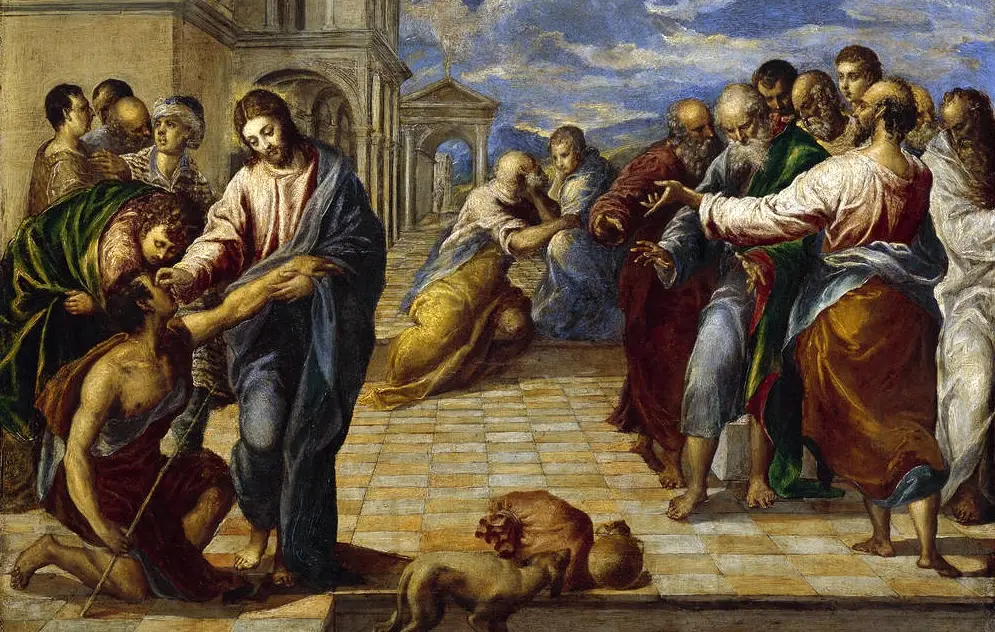
9 As he walked along, he saw a man blind from birth. 2 His disciples asked him, “Rabbi, who sinned, this man or his parents, that he was born blind?” 3 Jesus answered, “Neither this man nor his parents sinned; he was born blind so that God’s works might be revealed in him. 4 We[a] must work the works of him who sent me[b] while it is day; night is coming when no one can work. 5 As long as I am in the world, I am the light of the world.” …. see full passage
The episode in the Gospel of John 9:1–41 is one of the most structured symbolic narratives in the New Testament. It operates simultaneously on three levels: a physical miracle, a gradual revelation of Christ’s identity, and a judgement on spiritual blindness.
Suffering and the Works of God
The first movement concerns the origin of suffering. The disciples assume the common Jewish framework that suffering must correspond to a specific sin. They ask whether the man sinned or whether his parents did.
Jesus rejects this causal interpretation. The blindness is not punishment but an occasion through which “the works of God” will be revealed. This reframes suffering from simple retribution to participation in a larger divine purpose.
Christ then declares, “I am the light of the world,” preparing the reader for what follows. The miracle will not merely restore physical sight; it will illustrate what it means to see rightly.
The Sign of Mud and Water
The miracle itself contains deliberate symbolism. Jesus spits on the ground and makes mud, which he places on the man’s eyes. He then commands him to wash in the Pool of Siloam.
The action is striking because Jesus could easily have healed him with a word. Instead, the healing involves physical elements: earth, water, and something from Christ himself. Matter becomes the instrument of grace.
This structure strongly resembles the pattern of the sacraments: a visible element joined to the word and action of Christ. The man must also respond in obedience. The healing is not completed until he goes and washes as commanded.
The symbolism becomes even clearer when we recall that washing results in sight. In early Christian thought, baptism was frequently described as illumination, the moment when spiritual blindness is removed.
Incarnation and the Healing of Creation
Early Christian writers saw profound meaning in the mud itself. Augustine of Hippo interpreted the mixture of earth and divine action as a sign of the Incarnation.
The divine Word joins himself to the dust of the earth. In Genesis humanity is formed from the ground; here Christ uses the same material to restore sight. The Creator once again works with the dust of the earth, remaking what has been damaged.
The miracle therefore reveals a deeper truth about how God acts. Divine power does not bypass creation but enters into it. Matter becomes the means through which healing is given.
A Gradual Revelation of Christ
The man’s understanding of Jesus develops step by step throughout the chapter.
- He first refers to him simply as “the man called Jesus.”
- Later he calls him “a prophet.”
- Then he argues that Jesus must be “from God.”
- Finally, when Christ reveals himself, he confesses faith and worships him.
The miracle thus becomes a story of conversion. Sight grows gradually as the man reflects on what has happened to him.
The Pharisees and the Blindness of Certainty
While the blind man moves toward faith, the Pharisees move in the opposite direction. They focus on the fact that the miracle occurred on the Sabbath, arguing that making mud constitutes work.
Their certainty about the law prevents them from recognising the sign before them. Ironically, those who claim to see most clearly become the ones who are blind.
The narrative therefore reverses expectations. The beggar who once could not see comes to recognise the truth, while the religious authorities remain trapped in their assumptions.
The Judgement of Sight and Blindness
The climax occurs when Jesus declares why he has come: “that those who do not see may see, and those who see may become blind.”
The issue is not ignorance but pride. A person who recognises blindness can receive light. A person who insists on already seeing cannot.
This explains Christ’s final statement: “If you were blind, you would not have sin. But now that you say, ‘We see,’ your sin remains.”
The Pattern of Christian Conversion
The healed man expresses the essence of Christian testimony with remarkable simplicity: “One thing I do know, that though I was blind, now I see.”
This is the pattern repeated throughout Christian life. Encounter with Christ changes how reality itself is perceived.
The story therefore reveals something fundamental about the Christian faith. It is not merely the acceptance of a doctrine but the reception of a new vision. Through Christ, and through the physical signs by which he continues to work, the human person is gradually brought from blindness into light.